Who is on this subjectordered by the date of their first quote here
4 of 7 lanes rest on fewer than 5 quotes and are marked thin. Offsets are days from the middle first-quote date, 4 Apr 2024 — a date, and nothing else. It is not a claim about who reached a view first.
-
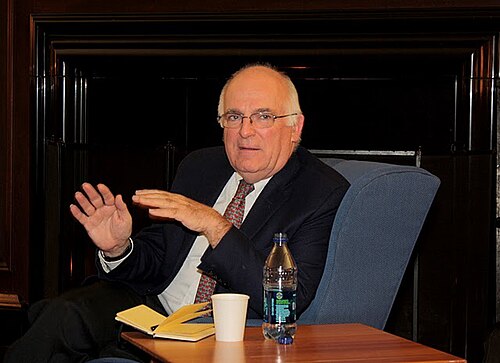 Sir Richard Dearlove
6
11 Oct 2019 – 13 Mar 2026
-1637 d
Sir Richard Dearlove
6
11 Oct 2019 – 13 Mar 2026
-1637 d
-
 David Friedberg
2
thin
19 Sep 2020 – 21 Dec 2025
-1293 d
David Friedberg
2
thin
19 Sep 2020 – 21 Dec 2025
-1293 d
-
 Bill Gurley
16
4 Apr 2024 – 4 Aug 2026
+0 d
Bill Gurley
16
4 Apr 2024 – 4 Aug 2026
+0 d
-
 Brad Gerstner
8
4 Apr 2024 – 28 Aug 2025
+0 d
Brad Gerstner
8
4 Apr 2024 – 28 Aug 2025
+0 d
-
 Gavin Baker
1
thin
27 Aug 2024 – 27 Aug 2024
+145 d
Gavin Baker
1
thin
27 Aug 2024 – 27 Aug 2024
+145 d
-
 Chamath Palihapitiya
1
thin
10 Oct 2025 – 10 Oct 2025
+554 d
Chamath Palihapitiya
1
thin
10 Oct 2025 – 10 Oct 2025
+554 d
-
 Scott Bessent
1
thin
Scott Bessent
1
thin
The chronologysourced and dated, oldest first
-
-
Sir Richard Dearlove
Dearlove recounts directly telling Gaddafi that disarmament deal required nuclear program inclusion despite Gaddafi's denial.
“Pretty much was blunt to that. And then I said, but the message I convey from the British and American governments is no deal unless the nuclear is involved.”
-
Sir Richard Dearlove
Dearlove told Gaddafi directly there would be no deal unless nuclear disarmament was included in negotiations.
“And I will reiterate, absolutely no deal unless that's included. I mean eventually, we end, we go back to thirty. It's now in the early hours of the morning, fly back to Tripoli.”
-
-
-
David Friedberg
Friedberg says nuclear plant regulatory costs rose from $100 million to $10 billion over two decades.
“And now it is so cost prohibitive. It's something like $10,000,000,000 now from maybe, you know, a 100,000,000, you know, two decades ago.”
-
-
-
Sir Richard Dearlove
Dearlove poses counterfactual about Hitler developing atom bomb instead of V2 rocket by 1944.
“So I suppose my counterfactual is, suppose Hitler had followed the advice of some of these scientists and created an atom bomb, rather than putting all his effort scientifically into the development of the V2 rocket, Had he, let's say in 1944,”
-
-
-
Brad Gerstner
Gerstner argues people would be more excited about nuclear fission if discovered today than they are about AI.
“if World War II never happened, the atomic bomb never happened, and someone just showed up in 2024 and said, I figured out this thing, it's nuclear fission, people would be like, oh my god, like, probably be more excited than you are about AI.”
-
Brad Gerstner
Gerstner states US nuclear deployment costs are limited by regulation, not technology, creating gap with China.
“our cost of deploying new nuclear fission infrastructure is limited by our own regulatory framework, not by the technology.”
-
Bill Gurley
Gurley says China has 300 nuclear plants in development versus zero in US, with 7-10 year build cycles.
“They have over 300 plants currently either being built or in development. We have zero, zero plants being built, I think 13 plants that are proposed, according to this data that we have here.”
-
Brad Gerstner
Gerstner notes Amazon bought land near nuclear facility while 30-35% US production comes from independent sellers.
“And, once again, according to Phil, about 35%, 30% of the production in The US is from independent energy producers who who basically sell to whoever they decide they want to sell to.”
-
Gavin Baker
Baker says only three US locations can provide gigawatt nuclear power, charging 10x average electricity rates.
“There's only basically three places in The United States today where you can get a gigawatt of power to a single data center that's reliable enough, I. E. That's nuclear.”
-
Brad Gerstner
Gerstner states China adds six to eight reactors yearly and will surpass US nuclear production by 2030.
“China who's adding six to eight new fission reactors per year, it's gonna add upwards of 25 or 30 over the course of the next, you know, five or six years, is expected to surpass The United States in nuclear power production by 2,030.”
-
Bill Gurley
Gurley says China builds nuclear plants at $2.5B per gigawatt versus $13B in the US.
“The plants in China that are the equivalent level three fission plants right now are coming on board at 2,500,000,000 per gigawatt. Right. So 13 to 2.5.”
-
Bill Gurley
Gurley finds industry insiders surprisingly unsurprised by China's 5x cost advantage in nuclear.
“Right. That's a shocking Delta. Yes. And one of, I would say the single most surprising thing to me of all the discussions I've had in the past two weeks with everyone that's in this industry is how few people are shocked by it.”
-
Bill Gurley
Gurley argues South Korea achieves China's nuclear costs as a democracy, making the comparison more relevant.
“South Korea is a democracy, a friend of The United they're at the same delivered price point as And they're doing it at scale and they're starting to export their technology.”
-
Brad Gerstner
Gerstner notes South Korea and China build reactors using US Westinghouse technology acquired through tech transfer licenses.
“both the South Koreans and the Chinese, right, are building on technology that they procured from The United States, from Westinghouse, under tech transfer licenses over the course of the past, you know, twenty or thirty years.”
-
Bill Gurley
Gurley explains the NRC is fee-based and environmental litigation prevents nuclear development in the US.
“And so those costs are extremely high. The second thing is litigation. So multiple special interest groups, particularly environmental groups will sue to stop any development whatsoever.”
-
Bill Gurley
Gurley calls nuclear investment a sport of emperors requiring multi-billions to first revenue.
“If that's a sport of Kings, this is a sport of emperors. Like you may be multi billions to first revenue.”
-
Bill Gurley
Gurley proposes rewriting nuclear regulation from scratch and eliminating lawsuit rights for important projects.
“And if you want to go build this next generation level three plant, I think you've got to rewrite the regulation from zero ground up, like make it thinner and tighter and two, I think we've gotten to the point where we got to say, this is so important, you can't sue these people.”
-
Bill Gurley
Gurley suggests leveraging Navy SMR technology with hyperscaler backing as a mini Manhattan Project approach.
“Or for the SMR one by leveraging what's been done in the Navy, maybe getting these hyperscalers behind it. And maybe that's a mini version of a Manhattan project.”
-
Bill Gurley
Gurley urges US to respect China and Korea's superior execution and pursue Manhattan Project approach.
“And then two, consider some type of Manhattan project like approach where you get out of the current environment,”
-
Brad Gerstner
Gerstner reports Oracle, Amazon, and Microsoft are all moving forward with nuclear-powered data center projects.
“Amazon is buying this nuclear powered Talon data center facility, and now Microsoft this week announces with CEG that they're going to bring 3 Mile Island out of retirement.”
-
Bill Gurley
Gurley says hyperscalers as nuclear customers may be 10x better than utilities, bringing more risk-tolerant innovators to SMR market.
“if the hyperscalers become part of the customer set for the nuclear startups that may be like 10x better than selling just to utilities alone.”
-
Brad Gerstner
Gerstner contrasts China building 350 nuclear reactors versus zero in the US.
“there are 350 nuclear reactors under fission reactors under construction in China. How many in The US?”
-
-
-
Sir Richard Dearlove
Dearlove flew into Libya in an unmarked plane as MI6 chief to negotiate Gaddafi's nuclear disarmament.
“when I was head of service, I flew into Libya in an unmarked plane to meet Gaddafi, to negotiate Libya's getting rid of their weapons of mass destruction.”
-
Sir Richard Dearlove
Dearlove states AQ Khan's laboratories sold Libya all the equipment needed to refine uranium and weaponize it.
“The kit having been sold to them by the father of the Pakistani nuclear program AQ Khan, so AQ Khan's KRL laboratories had sold all the kit for the Libyans to start refining uranium and creating HEU and then weaponizing.”
-
Brad Gerstner
Gerstner highlights US fission reactors cost four to five times more and none are being built.
“Why does it cost us four to five times to build a fission reactor in this country? Why are we building no nuclear reactors in this country?”
-
Chamath Palihapitiya
Palihapitiya predicts nuclear, natural gas, and solar will create electron abundance that diminishes oil demand within ten to twenty years.
“In the meantime, you have an abundance of electrons from nat gas. You have an abundance of electrons, frankly, from solar. And all of these things will ultimately diminish the net long bid to oil.”
-
Bill Gurley
Gurley states China builds nuclear fission plants at one fourth the price of US construction costs.
“So they are building new nuclear fission plants. So fission being old school, not new school, at one fourth the price that we do it here in The US.”
-
Bill Gurley
Gurley reports China builds nuclear fission plants at one-fourth the US price; South Korea does too.
“So fission being old school, not new school, at one fourth the price that we do it here in The US. So is South Korea, by the way.”
-
David Friedberg
Friedberg says China has 400 nuclear reactor sites under construction, representing 60% of total US power production capacity.
“Suddenly, that's 60% of The US power production capacity being built right now in just nuclear by China.”
-
-
-
Sir Richard Dearlove
Dearlove outlines Israel's plan to dispose of 450 kilos of highly enriched uranium and destroy Iran's missile production.
“I think the Israeli plan is pretty clear. It it it it's to dispose of the 450 kilos of HEU, which supposedly Tiny rich uranium.”
-
Bill Gurley
Gurley credits Pinker and others with shifting public perception on nuclear energy from negative to positive.
“Like like, the the the world has vilified this technology. It's amazing technology. It's clean technology.”
-
Bill Gurley
Gurley credits Pinker, Musk, and others for shifting nuclear energy perception from vilified to positive five years ago.
“Like like, the the the world has vilified this technology. It's amazing technology. It's clean technology. What Germany is doing is bad.”
-
Bill Gurley
Gurley states South Korea builds nuclear fission plants for one-fourth the US cost.
“South Korea, not China, South Korea can build a nuclear fission plant for one fourth the price that we can in The US.”
-
Bill Gurley
Gurley proposes global open source standard for nuclear reactors to lower costs.
“And I wonder what if the globe had a standard for, you know, fission based nuclear reactor?”
-
-
-
Scott Bessent
Bessent characterizes Iran as seeking nuclear weapons to kill Americans.
“Iran’s fanatics devote themselves to “Death to America” and seek nuclear weapons to do just that.”
-
Where they overlapsame programme, same subject
- Bill Gurley and Brad Gerstner — BG2 Pod, 3 appearances together